
Seeing a child have a seizure during a fever can be frightening. In those first moments, however, the priority is not to force the seizure to stop or immediately cool the child's body. The most important actions are to protect the child from injury, place them safely on their side, time the seizure and know when emergency medical help is needed.
Most febrile seizures are short and do not cause long-term harm. Some situations do require urgent medical attention, particularly when a seizure lasts more than 5 minutes, it is the child's first seizure, breathing is difficult, or the child does not recover normally afterwards. [1] [2] [3]
Seek emergency medical help if the seizure lasts more than 5 minutes, this is the child's first seizure, breathing is difficult, or the child does not recover normally afterwards. [1] [2]
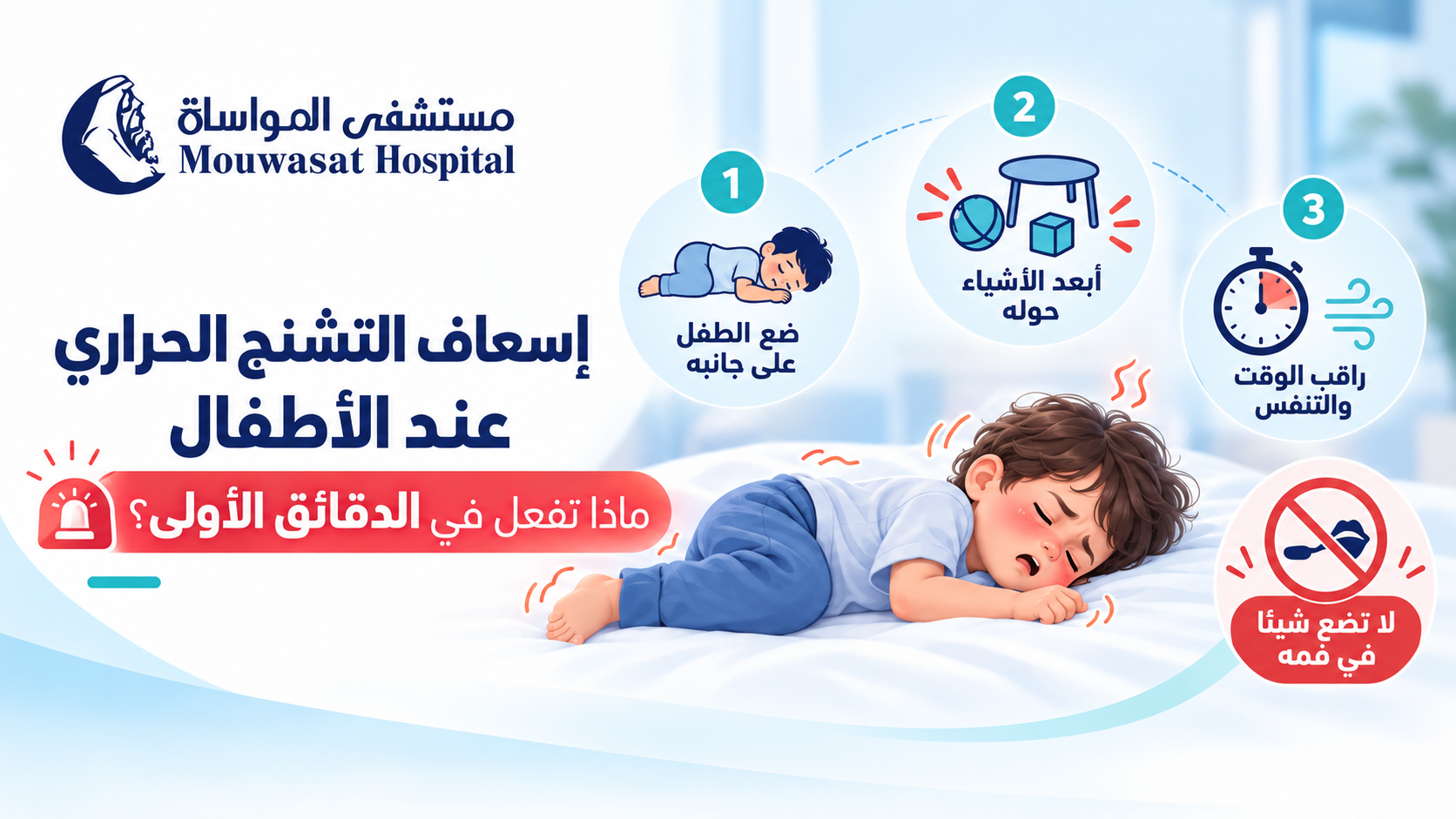
If your child starts having a seizure, focus on keeping them safe until the seizure stops or emergency help arrives.
Place your child on the floor or another low, safe surface. Move furniture, hard objects and anything sharp out of the way.
Saudi Ministry of Health guidance and the American Academy of Pediatrics recommend placing the child on their side so saliva or vomit can drain from the mouth rather than enter the airway. [1] [3]
Look at the clock as soon as the seizure begins. During a frightening event, a short seizure can feel much longer than it actually is, so accurate timing is extremely useful for both emergency decisions and medical assessment.
If possible, also observe whether the whole body is involved or only one side, whether another seizure occurs, and how the child behaves afterwards.
Do not hold the child's arms or legs down. Restraining the child will not stop the seizure and may cause injury.
A child cannot swallow their tongue. A spoon, cloth, finger or other object in the mouth can injure the teeth or jaw and may obstruct the airway. [2] [3]
Do not leave the child alone. Observe their breathing and skin colour and continue timing the event until the movements stop.
| Do not | Why? |
|---|---|
| Put anything in the mouth | It can injure the mouth or teeth and interfere with the airway. |
| Hold the child down | Restraint does not stop the seizure and can cause injury. |
| Give food, water or oral medicine | The child may not be able to swallow safely during the seizure or before fully recovering. |
| Place the child in a bath | During the seizure, airway safety and preventing injury matter more than trying to lower the temperature. |
| Automatically perform CPR while the child is convulsing | Most children resume normal breathing after the seizure. If breathing does not return after it stops, follow emergency-service instructions immediately. |
Seek emergency medical help if:
Saudi Ministry of Health seizure first-aid guidance identifies a first seizure, a seizure lasting longer than 5 minutes, breathing or waking difficulties, another seizure shortly afterwards, and injury during a seizure as reasons to seek emergency care. [2]
A child may be sleepy or confused for a while after a seizure. This can occur during the normal post-seizure recovery period.
After the movements stop:
Once your child is fully conscious, fever and discomfort can be managed appropriately. However, reducing the temperature does not reliably prevent another febrile seizure. [4]
For safe fever care after your child has recovered, read: how to reduce a child's fever: what the evidence supports and what the myths claim.

The two numbers answer different questions:
| Time | What it means |
|---|---|
| 5 minutes | An emergency-action threshold. An ongoing seizure beyond 5 minutes requires urgent medical help and may require treatment to stop it. |
| 15 minutes | One medical criterion used to distinguish simple from complex febrile seizures. It is not a time to wait before seeking help. |
A simple febrile seizure is typically generalised, lasts less than 15 minutes and does not recur within 24 hours. A complex febrile seizure may last longer, have focal features or recur during the same 24-hour period. [7]
A febrile seizure is a seizure that occurs in some young children around the time of an illness causing fever. They occur most commonly from about 6 months to 5 years of age, and the seizure may occasionally be the first sign that the child is becoming ill. [1] [3]
A child may temporarily lose consciousness, become stiff, have jerking movements of the arms and legs, roll their eyes or have a brief change in facial colour.
A very high fever is not always required. Febrile seizures can occur early in an illness, which is one reason aggressively chasing the thermometer number does not reliably prevent them.
Although the event can look frightening, short, simple febrile seizures generally do not cause brain damage, paralysis, intellectual disability or long-term neurological problems. [3]
Long, recurrent or focal seizures, or a child who does not recover normally, need urgent medical assessment because further treatment or investigation may be needed.
No. Having a febrile seizure does not mean that a child has epilepsy.
Epilepsy involves a tendency to have seizures that are not explained solely by fever or another temporary trigger, whereas febrile seizures occur in association with a febrile illness in young children.
Children who have experienced febrile seizures have a slightly higher future risk of epilepsy than children who have not, but the large majority do not develop epilepsy. [5]
Yes. Some children will have another febrile seizure during a future infection, but many will not.
Recent guidance from Cambridge University Hospitals reports recurrence in approximately 4 in 10 children who have experienced a febrile convulsion. Recurrence is more likely when the first event happens at a younger age or when there is a family history of seizures. [5]
A recurrence does not mean that the child has developed epilepsy, and it does not mean that parents failed to reduce the fever quickly enough.
This is one of the most common misconceptions about febrile seizures.
Paracetamol or ibuprofen may improve comfort during a fever, but they do not reliably prevent febrile seizures.
NICE specifically states that antipyretic medicines do not prevent febrile convulsions and should not be used specifically for this purpose. The American Academy of Pediatrics gives the same advice. [3] [4]
Do not give fever medicine to a child without fever solely because they have previously had a febrile seizure, and do not use extra doses or shorten dosing intervals in an attempt to prevent a seizure.
Useful details include:
If you are unsure whether the temperature itself is abnormal, see: normal temperature in children by measurement site.
For a broader guide to fever severity by age and symptoms, see: child fever treatment by age, temperature and symptoms.

If your child has a febrile seizure, the most important first-aid steps are to turn them onto their side in a safe place, remove objects that could cause injury, time the seizure, avoid restraining them and never put anything in their mouth.
Seek emergency medical help if the seizure lasts more than 5 minutes, it is the child's first seizure, breathing is difficult, seizures recur, or the child does not recover normally afterwards.
Most simple febrile seizures do not cause brain damage and do not mean that a child has epilepsy. Fever-reducing medicines also do not reliably prevent future febrile seizures.
For specialist assessment and follow-up, visit Pediatrics at Mouwasat Hospital.