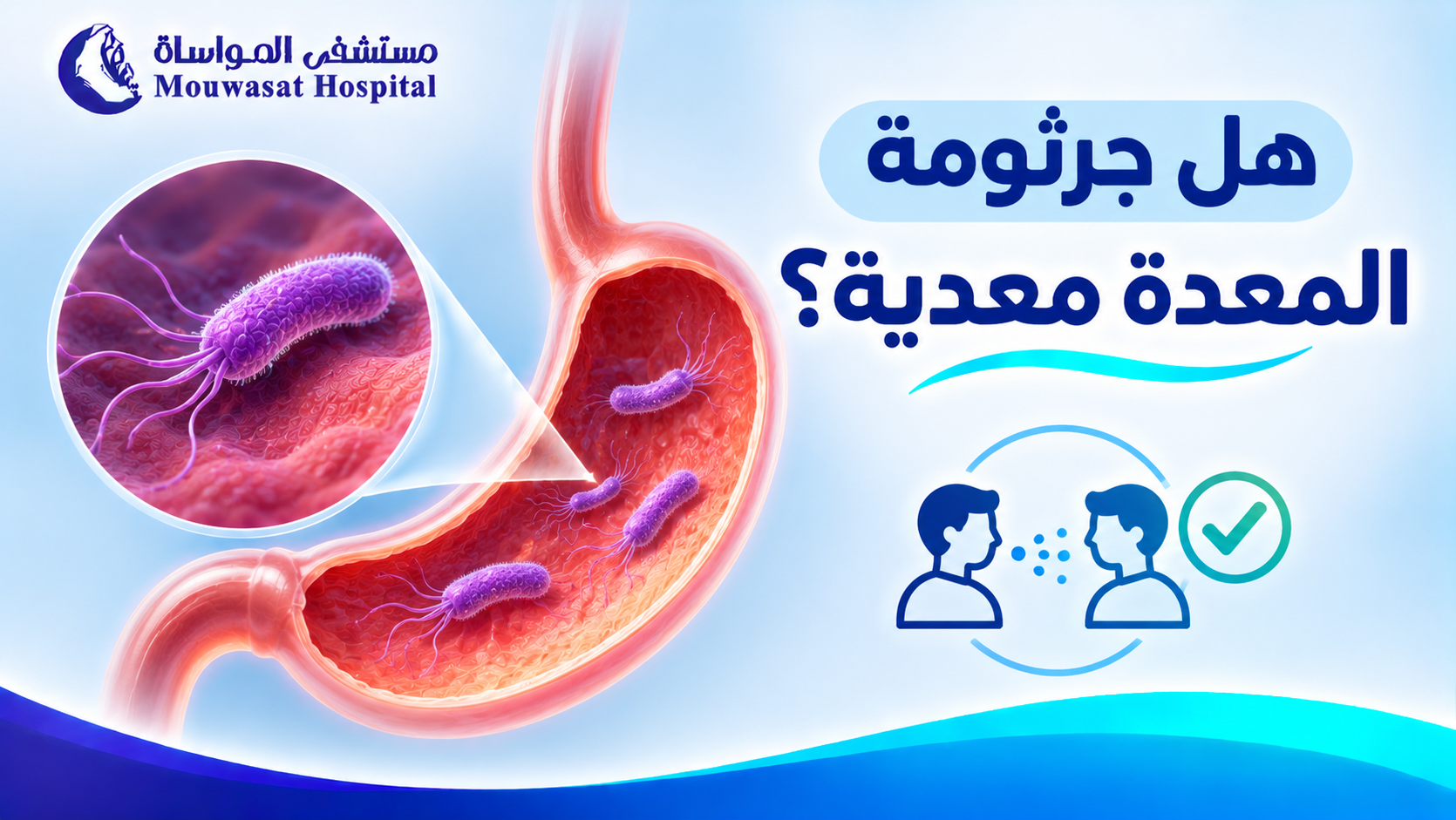

Yes. Helicobacter pylori (H. pylori) can spread between people, although the exact mechanisms responsible for every infection are not completely understood.
Medical sources indicate that transmission may occur through exposure to an infected person's saliva, vomit, or stool, as well as through contaminated food or water. Living with someone who has H. pylori is also associated with a greater likelihood of infection. [1] [2]
This does not mean that an infected person needs to be isolated from their family, or that every spouse or child sharing the home will become infected. Good hand, food, and water hygiene remain the main practical precautions.
H. pylori is a bacterial infection that can spread between humans, but researchers have not identified one single route that explains every case.
Saudi Ministry of Health guidance notes that infection is more common among household members of an infected person and identifies living with someone who has H. pylori as a risk factor. [1]
Many infections are acquired during childhood and can remain in the stomach for years without treatment. [3]
For a general overview, see H. pylori: Causes, Diagnosis, Treatment and When to See a Doctor.
| Possible route | How exposure may occur |
|---|---|
| Oral-to-oral exposure | Saliva from an infected person is considered a possible route. |
| Fecal-oral exposure | Poor hand hygiene may transfer organisms from stool to food or the mouth. |
| Vomit | Medical sources also describe exposure to infected vomit as a possible transmission route. |
| Food and water | Contaminated food or inadequately treated water may contribute to transmission. |
| Shared utensils | Saudi health guidance recommends avoiding shared eating and drinking utensils. |
NIDDK states that H. pylori may spread through contact with an infected person's saliva, vomit, or stool, and through contaminated food or water. [2]
Yes. People living with an infected household member have a higher likelihood of H. pylori infection.
Household members may share several potential exposure factors, including:
Household transmission has become clinically relevant enough that the 2024 American College of Gastroenterology guideline now recommends testing adult household members of H. pylori-positive individuals. [4]
Partners may have a higher opportunity for shared exposure because they live together, share food and the same environment, and have prolonged close contact.
However, one partner should not be assumed to have H. pylori simply because the other has tested positive. Active infection should be established with an appropriate test.
It is also often impossible to determine when an infection was acquired, because many people first acquire H. pylori during childhood.
No. Antibiotic treatment should not be given solely because someone has been exposed to a person with H. pylori.
However, the 2024 ACG guideline recommends testing adult household members of people with confirmed H. pylori infection. [4]
Treatment can then be selected if infection is confirmed.
Saliva is considered one of the possible routes involved in H. pylori transmission. Saudi Ministry of Health, NIDDK, and Mayo Clinic sources all describe exposure to infected saliva as a potential pathway. [1] [2] [3]
However, this does not mean that every kiss transmits H. pylori, and it is generally impossible to determine the source of an individual's infection on this basis alone.
It is sensible to avoid sharing used eating and drinking utensils.
Saudi Ministry of Health guidance specifically recommends avoiding shared eating and drinking utensils as a preventive measure. [1]
This can include:
Sharing a properly prepared family meal is not the same as directly sharing a used spoon or cup. Safe food preparation, hand hygiene, and clean water remain important.
Because stool is a possible transmission pathway, careful hand washing after using the bathroom can reduce the opportunity for organisms to reach food or the mouth.
Recommended precautions include:
Simply sharing a bathroom does not mean infection will automatically spread when appropriate hygiene is maintained.

No. Saudi Ministry of Health guidance does not recommend isolating a person with H. pylori from their household. [1]
Normal household life can continue while sensible precautions are taken.
Practical measures include:
This is an area where recent clinical guidance has changed.
The 2024 American College of Gastroenterology guideline includes adult household members of H. pylori-positive individuals among those for whom testing is recommended. [4]
Testing should generally identify active infection, such as with an appropriate urea breath test or stool antigen test, rather than relying only on blood antibody testing.
Test timing can be affected by antibiotics, bismuth, proton pump inhibitors, and other medicines.
For test selection and preparation, see H. pylori Testing: Breath Test vs. Stool Test and When to Test.
H. pylori is frequently acquired during childhood, and household crowding and living with an infected person are recognized risk factors. [3]
However, a parent's positive result does not mean children should automatically receive antibiotics, and pediatric testing should not simply copy an adult test-and-treat approach.
Children require age-appropriate assessment because abdominal symptoms have many possible causes and pediatric H. pylori guidance differs from adult management.
Yes. Most people with H. pylori infection do not have obvious symptoms. [3]
Therefore, feeling well does not prove that a household member is uninfected. At the same time, digestive symptoms alone do not establish H. pylori infection.
For more about symptoms, see H. pylori Symptoms: When Should Symptoms Lead to Testing?.
| Action | Why it matters |
|---|---|
| Wash hands after using the bathroom | Reduces fecal contamination of food and hands. |
| Wash hands before handling food | Helps reduce contamination during preparation and eating. |
| Use safe water | Contaminated water is a possible transmission pathway. |
| Wash fruit and vegetables | Reduces exposure to contaminated sources. |
| Avoid sharing used eating utensils | Reduces direct saliva exposure. |
The primary purpose of H. pylori treatment is to eradicate the infection and reduce complications such as peptic ulcer disease.
Feeling better after treatment does not prove that the bacteria have been eradicated. An appropriate test-of-cure should be performed at the correct time.
For more information, see H. pylori Treatment and Cure Rates.

The Gastroenterology & Endoscopy Department at Mouwasat Hospital provides assessment for gastrointestinal disorders and includes H. pylori testing and treatment for patients with conditions such as gastritis or peptic ulcer disease according to clinical need.
If someone in your household has confirmed H. pylori and you are unsure whether you should be tested, a clinician can review your age, symptoms, medical history, and medications and determine an appropriate testing plan.
Yes. H. pylori can spread between people, with possible routes involving saliva, vomit, stool, and contaminated food or water.
H. pylori can occur in multiple members of the same household, including partners. A partner should not be assumed to be infected without appropriate testing.
The 2024 ACG guideline recommends testing adult household members of H. pylori-positive individuals.
Saliva is considered a possible transmission pathway, but this does not mean that every kiss transmits H. pylori or that the source of infection can be identified from kissing alone.
H. pylori transmission is not explained as a simple sexually transmitted infection. Household exposure includes shared environment, food, water, and prolonged close contact.
Saudi health guidance recommends avoiding shared eating and drinking utensils because saliva exposure is one possible transmission route.
H. pylori can cluster within households and infection is often acquired during childhood, but a parent's infection does not mean a child will necessarily become infected.
No. Routine household isolation is not recommended. Good hand hygiene, safe food and water, and avoiding shared used utensils are more appropriate precautions.
Yes. Many infected people have no symptoms, so the absence of stomach pain or bloating does not rule out infection.
No. Antibiotics should not be given as household prophylaxis. Infection should be appropriately assessed and treatment provided to people in whom H. pylori is confirmed.
Simply sharing a bathroom does not mean transmission will occur. Careful hand washing after using the toilet is important because stool is a possible transmission pathway.
Reinfection can occur, but recurrent digestive symptoms do not prove that H. pylori has returned. Appropriate testing is needed to distinguish active infection from other causes of symptoms.
H. pylori can spread between people, and possible transmission routes include saliva, vomit, stool, contaminated food, and unsafe water.
People living with someone who has H. pylori have greater exposure risk, but infection is not inevitable and household isolation is not required.
Good hand hygiene, safe food and water, and avoiding shared used eating and drinking utensils are practical preventive measures.
Recent ACG guidance also recommends testing adult household members of a person with confirmed H. pylori rather than providing antibiotics without confirming infection.
Medical disclaimer: Do not take antibiotics for H. pylori simply because you live with an infected person. Diagnosis and treatment should be based on appropriate medical assessment.